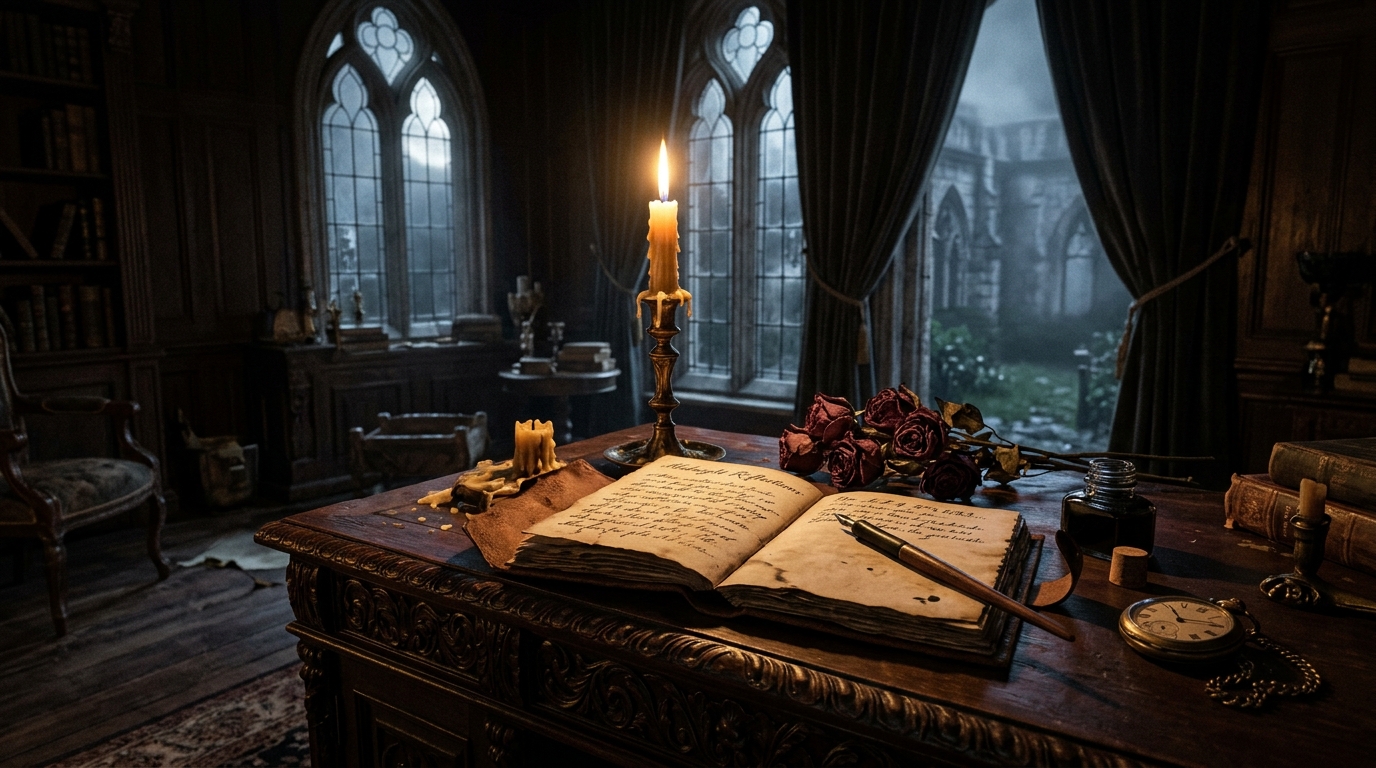
There is a moment, typically around half-past eleven on a Manitoba autumn night, when the house settles into its foundations and the world outside ceases its ceaseless mechanical hum. The wind off the stubble fields drops to a low murmur against the double-paned glass. The blue light of monitors is banished; only the warm, trembling amber of a beeswax candle remains.
In this sanctuary of shadow, thought finally slows down enough to be examined.
The Tyranny of Daylight
Daylight is an imperialist. It demands productivity, utility, correspondence, and urgency. It insists that every passing minute be justified on an invoice or converted into visible social motion. In the relentless glare of noon, human beings become functional machines—busy, distractible, and perpetually shallow.
Night, however, makes no such demands.
The dark is generous. It draws a heavy velvet drape across the infinite horizon of the Western Manitoba plains, compressing the universe down to the intimate circle of warm candlelight illuminating a sheet of rag paper. In the shadows, you are no longer an instrument of commerce; you are merely a consciousness sitting in conversation with yourself.
“To love the night is to love truth without its daylight cosmetics. In shadow, the pretenses of vanity evaporate, leaving behind only what is durable.”
The Physicality of Ink on Parchment
In an age where human thought is reduced to ethereal impulses flickering across silicon wafers, writing by hand with an ink-fed pen feels like an act of quiet rebellion.
When you touch steel to paper, there is friction. There is an acoustic whisper—the nib tooth catching slightly against the tooth of the cotton fiber. There is the wet sheen of dark sumi ink that dries from shimmering obsidian to a matte, permanent carbon residue.
You cannot backspace a stroke of black ink. You cannot delete an erroneous sentiment with a flick of the thumb. Every mark is an irrevocable commitment. It forces a deliberate cadence of thought. Before you set the nib down, you must know what you believe.
Solitude on the Prairie Margins
To live in rural Western Manitoba is to understand scale. In the cities, human beings construct labyrinths of concrete and neon to deceive themselves into believing they are the central spectacle of the cosmos.
Here, you only need to step outside your backdoor at one in the morning.
Above you arches the celestial vault—vast, cold, unblinking, stretching from the Assiniboine coulees north to Riding Mountain and west into the Saskatchewan void. The temperature bites sharp and dry. The northern lights sometimes bleed emerald and pale violet across the zenith, indifferent to human observation.
In that colossal silence, one does not feel diminished; one feels anchored. When you return inside to the desk and latch the heavy timber door behind you, the candle flame seems all the more precious for the immensity of the cold dark surrounding it.
Here, in the noctuary, the night is not something to be endured until dawn. It is the destination.