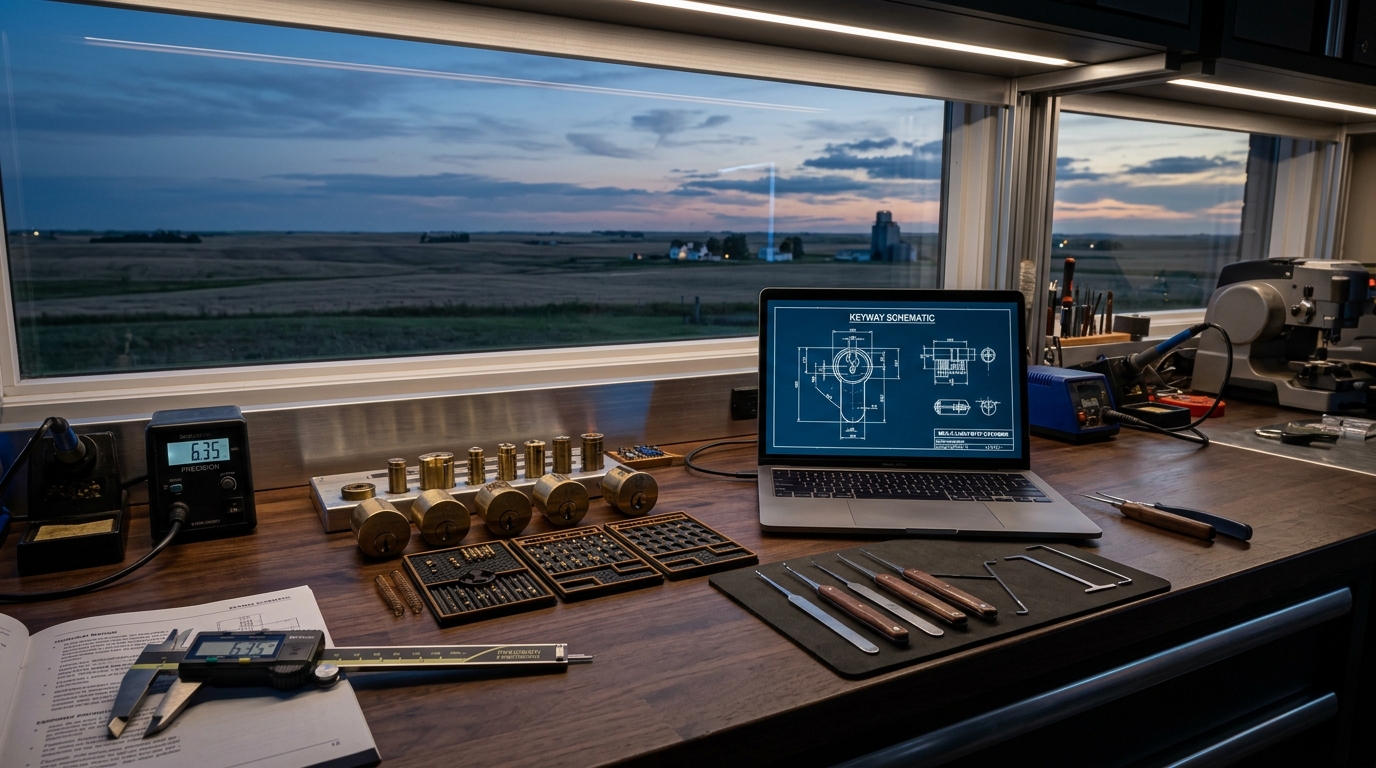
In the early decades of the twentieth century, every booming railway town across Western Manitoba—from Souris to Minnedosa—had a solid brick bank or credit union anchored by a massive cast-iron safe. Built like battleships to withstand dynamite attacks from wandering train bandits, these safes housed mechanical combination locks that were marvels of Victorian hand-fitted precision.
Last month, during the demolition salvage of an old municipal hall north of Minnedosa, we were tasked with recovering and restoring an authentic 1912 Victor Safe & Lock Co. 4-Wheel Combination Lock.
The dial was frozen solid, caked with hardened grease, coal dust, and surface oxidation. Here is how we disassembled, restored, and re-calibrated this historical piece of prairie engineering.
Mechanical Anatomy of a 4-Wheel Pack
Modern consumer safes typically use 3-wheel locks (such as the standard Sargent & Greenleaf 6730). This commercial 1912 Victor features four tumbler wheels plus a heavy brass drive cam, providing over 100,000,000 theoretical combinations.
VICTOR 1912 COMBINATION LOCK SPEC SHEET
- Manufacturer: The Victor Safe & Lock Co. (Cincinnati, Ohio)
- Year of Production: Circa 1910–1914
- Wheel Count: 4 Tumbler Wheels with adjustable brass curb rings
- Dial Graduations: 100 increments, hand-engraved and enameled
- Gate Type: Hand-cut rectangular gates for drop-lever fence bar
- Restoration Time: 38 bench hours across 3 weeks
  [ Heavy Brass Dial ]
         |
    (Drive Spindle)
         v
  [ Drive Cam ] === (Drive Pin) ===> [ Wheel 1 ]
                                            | (Fly)
                                     [ Wheel 2 ]
                                            | (Fly)
                                     [ Wheel 3 ]
                                            | (Fly)
                                     [ Wheel 4 ]
                                            |
                                  [ Fence Drop Lever ] ===> (Boltwork Retracts)
The Teardown: Ultrasonic Cleaning & Chemical De-rusting
- Dial Spindle Extraction: The spindle was gently drawn using a brass-nosed hydraulic puller to avoid mushrooming the century-old threads.
- Grease Solubilization: A century ago, safe technicians used tallow and early mineral greases that over decades polymerize into a concrete-like shellac. We soaked the brass wheel pack in a warm bath of safe non-etching solvent, followed by 45 minutes in an industrial ultrasonic cleaner at 65°C.
- Rust Conversion: The iron fence lever and case cover were soaked in an Evapo-Rust bath for 24 hours to eliminate red oxidation without stripping the original black japanned enamel finish.
Machining the Missing Brass Drive Fly
Upon inspection, the drive fly between Wheel 2 and Wheel 3 was sheared off—likely caused by someone decades ago attempting to force the dial with a pipe wrench after the safe was abandoned.
On the bench mini-lathe:
- Turned a replacement fly from high-tensile 360 brass rod.
- Milled the 0.040" interlocking stop tab on our precision milling attachment.
- Hand-stoned the mating edges to ensure frictionless rotation without slop.
4 turns Left, 3 turns Right, 2 turns Left, 1 turn Right to STOP).Decoding the Lost Combination
Once reassembled and lubricated with synthetic sub-zero clock oil, the wheel pack turned with zero drag. By visually aligning each gate under the fence bar and reading the dial index through our bench alignment jig, we decoded the original combination:
Original Combination Discovered:
  - Turn LEFT  4 times to:  72
  - Turn RIGHT 3 times to:  28
  - Turn LEFT  2 times to:  54
  - Turn RIGHT 1 time to:   16
  - Turn LEFT slowly until dial stops at 92.
When the fence lever dropped into all four aligned gates with a distinct, hollow clack, the mechanical satisfaction was indescribable.
This safe mechanism now sits proudly in our workshop display cabinet—a testament to prairie history, mechanical longevity, and the craft of lockmaking that transcends generations.