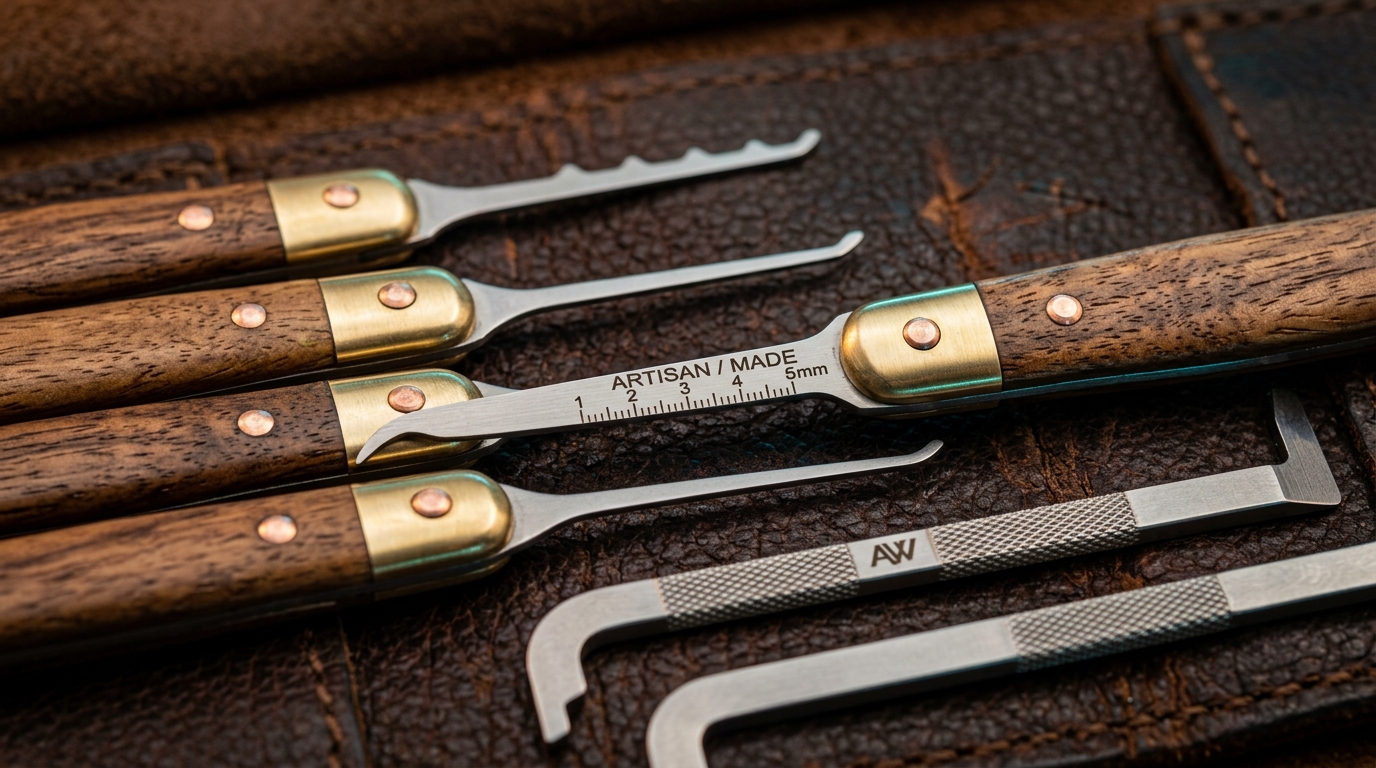
In the trade, tools are an extension of your nervous system. When you are picking a serrated spool pin in a tight European keyway, your eyes can’t see the shear line; you are relying 100% on tactile friction and microscopic acoustic resonance transmitted up through the pick shank into your fingertips.
Most commercial mass-manufactured picks use cheap stamped steel with dipped rubber or plastic handles that dampen vibration. Over the past month in the wood and metal shop, I set out to produce a set of heirloom-grade tension tools and picks combining 301 High-Yield full-hard stainless steel, solid C360 free-machining brass bolsters, and salvaged Manitoba black walnut scales.
Material Selection & Metallurgy
MATERIALS BILL // ARTISAN PICK BUILD
- Blade Stock: 301 High-Yield Stainless Steel Strip (0.019" / 0.48mm and 0.015" / 0.38mm)
- Yield Strength: 270,000+ PSI (Extreme flexural memory without taking a set)
- Handle Bolsters: C360 Brass round bar stock, lathe-turned and contoured
- Scales: Manitoba Black Walnut, seasoned 4 years, stabilized in cactus juice resin
- Fasteners: Solid copper rod rivets (peened by hand over countersunk brass washers)
- Tool Roll: 5 oz Wickett & Craig harness saddle leather, hand saddle-stitched with 0.8mm waxed poly cord
Why 301 High-Yield? Unlike standard 304 or 400-series stainless, 301 HY undergoes extreme cold rolling that induces high dislocation density in the crystal lattice. When a pick blade enters a paracentric keyway and bends around warding, 301 HY snaps back dead true without ductile deformation.
The Machining Process
1. Profiling the Blades
The blanks were shaped using a low-speed water-cooled diamond wheel grinder to prevent heat buildup. Annealing the steel by overheating would destroy the spring temper.
The three core profiles shaped for this run:
- The Short Flat Hook: 0.019" thickness for standard American pin tumblers.
- The Deep Reach Gem: 0.015" thickness with a subtle 15-degree teardrop tip for navigating high-low bittings behind deep warding.
- The Micro Quint Rake: Gently radiused cycloidal waves for rapid raking of legacy wafer cylinders and padlock cores.
Blade Profile:
  [========================\____________/\_______]
  <-- Shank Spine (0.019") -->           ^ 15° Tip
2. Laser Graduation Marks
Using our bench fiber laser, I etched microscopic millimeter depth index marks (1mm to 6mm) directly along the pick shank. When working inside a dark keyway with zero external visibility, these index lines allow you to instantly determine whether your pick tip is resting on pin 3 or pin 4 simply by looking at the cylinder plug face.
3. Turning the Brass Ferrules & Fitting Walnut Scales
The brass ferrules were turned on the shop mini-lathe to a seamless rounded shoulder that transitions smoothly from the metal pick shank into the walnut handle.
The walnut wood scales were rough-cut, drilled with a carbide drill press, and pinned with solid copper rivets. After peening the rivet heads flush, each handle was hand-sanded from 220 grit through 2000 grit, followed by three coats of boiled linseed oil and buffed with carnauba wax.
Crafting the Leather Roll
A good set of precision tools deserves proper armor against the prairie elements.
I cut a single piece of 5 oz English bridle leather, grooved stitch lines, and punched chisel holes at 4mm spacing. Using two harness needles and traditional two-handed saddle stitching, the roll features 8 custom-sized pockets for the pick shanks, plus two dedicated sleeves for knurled top-of-keyway (TOK) prybars.
This tool roll now lives in my field pouch, ready for both delicate laboratory safe-lock teardowns and urgent rural service calls.